Archive for category Costars

Maureen O’Hara visits birthplace of friend John Wayne in last public outing

Irish screen legend Maureen O’Hara (92) has said her visit this weekend to the birthplace of her friend and acting co-star John Wayne in Iowa will be her last public appearance.
She announced the end to her public life as her family said they had hired new Irish lawyers to seek more information about her finances and assets, in Ms O’Hara’s and her family’s long-running dispute with her former personal assistant Carolyn Murphy.
Speaking from her home in Boise, Idaho, an emotional O’Hara said she was “weepy and teary” that her visit to Wayne’s birthplace in Winterset, Iowa, for the birthday celebration of his life would be her last public outing. It is “best to have the last of something”, she said.

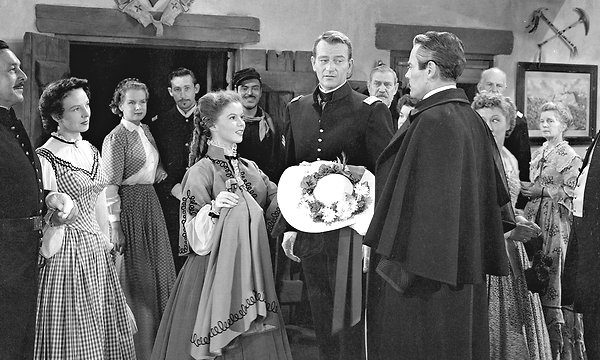
Ms O’Hara paid a final tribute to her long-time friend, with whom she starred in five movies including the 1952 classic, The Quiet Man , which was made in Ireland. Wayne died of cancer in 1979. “He meant so much to me and all the people in the world who enjoyed his movies and his speeches and his sayings and his joking and teasing of people,” she said.
She again refused to reveal what she famously whispered in Wayne’s ear at the end of The Quiet Man , repeating that she would take one of Hollywood’s best-kept secrets with her to her grave. “I’m afraid so,” she said.
In a statement released by her grandson, Conor Fitzsimons, Ms O’Hara said that “after 75 years as a performing artist, it’s time to start taking my final bows”.
She said in an interview that she hoped her dispute with Ms Murphy could be resolved without resorting to further court action. “You hope that you won’t argue much any more,” she said.

‘Going to court’
The Irish-American actor made her comments as her grandson said that the family had hired one of Dublin’s biggest law firms, Arthur Cox, to seek more information about her business records.
“The bottom line is we are going to court,” he said.
“We have asked and requested information but we have heard nothing further for almost a year. We are going to have to go a legal route.”

Ms O’Hara left her home in Glengarriff in west Cork last year after having lived in the area since 1968. Weeks earlier she held a press conference to discuss the litigation she was embroiled in.

Mr Fitzsimons said his grandmother was living in a house near his home in Idaho under the 24-hour care of three minders. She has since sued a US lawyer in a New York court seeking the return of files on her assets and finances.
The Irish High Court ruled against a legal challenge by Ms Murphy last November seeking to reassert power of attorney over Ms O’Hara and her affairs which she held since the mid-2000s.

Ms O’Hara spoke last year of being “heartbroken” about her dispute with her long-time friend and close companion Ms Murphy.

A spokesman for Ms Murphy said at the time that she had “always acted in Ms O’Hara’s best interest” and that she was “dealing with these unfortunate affairs in the appropriate way”.

Source

Western character actor Harry Carey Jr. dies at 91

Dobe, in Tombstone (1993) (photo: James Pepper)

Dobe, in Tombstone (1993) (photo: James Pepper)

LOS ANGELES — Harry Carey Jr., a character actor who starred in such Westerns as “3 Godfathers” and “Wagon Master,” has died. He was 91.

His daughter, Melinda Carey, said he died Thursday of natural causes surrounded by family at a hospice facility in Santa Barbara, Calif.

“He went out as gracefully as he came in,” she said Friday.

Carey’s career spanned more than 50 years and included such John Ford classics as “She Wore a Yellow Ribbon,” “The Searchers” and “The Long Gray Line.” Later in life, he appeared in the movies “Gremlins” and “Back to the Future Part III.”

His memoir, “Company of Heroes: My Life as an Actor in the John Ford Stock Company,” was published in 1994.

While he lacked the leading-man stature of longtime friend and co-star John Wayne, Carey’s boyish looks and horse-riding skills earned him roles in many of Ford’s films.

He and fellow character Ben Johnson famously learned to stand simultaneously on two galloping horses – a trick known as roman riding – for the 1950 film “Rio Grande” starring Wayne.

“My journey has been that of a character actor,” he wrote in his memoir. “I’ve worked with the great and the not-so-great. But mostly I’ve worked with men and women who loved their profession, and who like me, had kids to raise and houses to pay for.”

Carey was the son of silent-film Western star Harry Carey Sr. and actress Olive Carey. He was born on May 16, 1921, on his family’s ranch and graduated from Hollywood’s Black-Foxe Military Institute.

During World War II, he served in the Navy and worked with Ford on films for the Navy.

He is survived by his wife, a son, two daughters, three grandchildren and two great-grandchildren.

Glen Campbell on music, memories and saying goodbye to life on the road

John Wayne (left) with Glen Campbell - 1974 Photo: REXFEATURES

Six months ago, the one-time Beach Boys frontman and country singer par excellence was told he had Alzheimer’s. Now he talks exclusively about his music and his memories.

In November 2003, Glen Campbell drove his BMW into another car in Phoenix, Arizona. He then left the scene of the incident and was later picked up at home by Arizona police. Smelling alcohol on his breath, they arrested him and took him to Maricopa County jail. There, Campbell kneed a sergeant in the thigh, which led to an additional charge of aggravated assault on a police officer. He was convicted of extreme DUI (driving under the influence) and sentenced to 10 days in prison; his police mugshot was made public and became a widely viewed internet sensation.

It was, unfortunately, one of Campbell’s most famous moments in the spotlight, one that temporarily threatened to obliterate the country singer’s many achievements: his classic hits (Rhinestone Cowboy, Wichita Lineman, Galveston, By the Time I Get to Phoenix); his work with some of the biggest names in American rock history; or his acting turn alongside John Wayne in the 1969 version of True Grit.

For a while, the public forgot all about Campbell’s times fronting the Beach Boys, touring with the Doors and playing guitar on recordings by Frank Sinatra (Strangers in the Night), Dean Martin (Everybody Loves Somebody Sometime), the Righteous Brothers (You’ve Lost That Lovin’ Feelin’) and Elvis Presley (Viva Las Vegas). But they were very much reminded of the revelations of his addictions to cocaine and alcohol in the Seventies.

In his mugshot, Campbell, then aged 67, appeared wild haired and slovenly. For a man who had supposedly not touched drugs or alcohol since finding God, and his fourth wife, a quarter-of-a-century earlier, the whole episode was hard to fathom. This was not Campbell’s normal behaviour.

“I first noticed some things maybe eight years ago,” Campbell’s wife, Kim, tells me. It is June 2011 and we are sitting in the lounge of the couple’s home in Malibu, California. “But they could just be normal things ’cause lots of people have their little moments. [Things like] ‘why’d I come into this room?’ We’ve all done that, right?”

“Yeah!” hoots Campbell, who is sitting next to her on the sofa. ‘“Hey, where’s my shorts at?’ Hah hah!”

“But they were so abnormal that I just discounted them,” Kim continues. “When we lived in Phoenix I’d say, ‘something’s in the garage’, and he’d say, ‘where’s the garage?’, I’m like, ‘what do you mean, where’s the garage?’ So that was very abnormal. But it was also not something that occurred every day.”

Does she think this explains the arrest? “I think it could very well. Because there were some things going on that Glen was struggling with. And he was getting anxiety. And anxiety seems to be a symptom of this disease.”

Glen: “What disease?” Kim: “Alzheimer’s.”

“Oh, Alzheimer’s,” says Glen absent-mindedly. He takes a slurp of his iced tea. “No. I don’t know. I still play my guitar and sing.”

Campbell, a father of eight and with 45million record sales to his name, does still play guitar and sing – on his new album, as richly and evocatively as he ever did. But he might not be doing it for much longer. Ghost on the Canvas is, he says, his last album.

Well, he qualifies that in an open letter he’s publishing alongside the album. It’s “the last studio record of new songs that I ever plan to make”, which leaves open the possibility of a live album, or an album of cover versions, like his last one, 2008’s Meet Glen Campbell.

But then later in the letter, he qualifies that qualification: “I’ve done a lot in my life – played, sang, toured, hosted a TV show, acted in a movie. Most of the things that happened were because of the music, because of the records, and now it’s time to just close that book.” Campbell, 75, has Alzheimer’s. He and Kim received the diagnosis six months ago.

They’ve decided to tell the world now because he’s about to embark on what will definitely be his last tour. The couple didn’t want concert-goers to mistake any onstage forgetfulness for drunkenness.

“Music is a natural memory aid,” says Kim, explaining the medical benefits of her husband not hanging up his plectrum just yet. “And it really works for him ’cause that’s what he does: music. So he’s able, most of the time, to remember and even learn new things because they’re set to music.”

Our interview runs like this: starting at around 9.30am, first Campbell and I talk for 45 minutes or so. His long-standing PR and friend sits nearby. Midway through his golf buddy turns up, ready for that day’s round – the interview has been scheduled early to make sure we don’t impinge on this beloved part of Campbell’s daily routine. Kim hovers in the kitchen then, at my invitation, joins us for the last 15 minutes to discuss living with the disease.

In the early part of our conversation, during which I ask about Ghost on the Canvas, Campbell struggles to recount details of the new album.

As we dive further back in time, his recall – and speech – is clearer, more lucid. Towards the end he seems to become distracted, his speech is garbled, and he’s tired. He also repeatedly forgets what we’re talking about. He does it so often it’s like a comic skit. Afterwards I ask his PR if that was him genuinely forgetting, or if he was pulling mine and Kim’s legs. “A bit of both, I think,” the PR replies.

Kim confirms the insidious nature of the amnesia brought on by Alzheimer’s.

“I think that’s the hardest thing for people with this disease – learning new material, new information. They just can’t store it. So we definitely rely on a teleprompter [on stage]. But if it was just learning lyrics and having to recite them that would be really difficult.”

Kim sets out Campbell’s daily drug regimen: Namenda, Galantamine and, for his anxiety, a dose of Lexapro – “and that does miracles for him. Without it,” she says, looking fondly at her husband, “he just gets anxiety, just crazy. He just can’t handle it.”

As we near the end of our time together, I ask Campbell: does making music do as good a job as all the drugs?

“Oh yeah!” he beams, shifting his baseball cap on his head – it’s been signed by former vice-president Dan Quayle, with whom he once played 18 holes. “I don’t, I haven’t had anything in quite a while. Any of these things, I mean. Just great, I’m sure glad.” Momentarily lost in the conversational seas, he turns to Kim, as if seeking an anchor.

“Have you been giving me something? I take something at the house don’t I? Well, I’m 75, I figure that we’ll get another coupla decades,” Campbell grins.

As for the Fifties? Campbell remembers them well. At the beginning of the decade he was living on the family farm in Billstown, Arkansas, one of 12 children. His clearest memory?

“Looking a mule in the butt, hah hah!” laughs the singer. Guiding a plough as a beast of burden dragged it through the fields wasn’t young Glen’s favourite pastime. He preferred to play the guitar that he’d had from the age of four. But for the hardscrabble Campbell kids there was always work to be done.

“Dad would sit one of us on the cultivator, then before you knew it Daddy wasn’t sitting up there with us no more. He was over there driving a damn goat or whatever it was! And Mom was like, [screech] ‘you’re gonna kill one of ’em kids, they’ll fall off of there!’” Campbell slaps his thighs at the memory.

“But yeah, I wanted to get out of there. I wanted to play my guitar and sing. And I did. I started with my Dad’s sister. Yeah, anyway, she came out to Arkansas and I played. And I auditioned for her husband. They were in Albuquerque at that time. They had a five-days-a-week radio show. And I turned up, you know, got a little audition there with him, and sang, and he gave me the job. We had a five-days-a-week radio show,” Campbell says again.

Those early days playing with his uncle, Dick Bills, on the Albuquerque radio show were clearly one of the pivotal moments in his life. Not least because Campbell mentions them, out of the blue, at three subsequent points in the conversation. It’s like the needle of his memory is stuck in a distant groove.

It was in Albuquerque that he first met Elvis Presley. The year was 1957, and Campbell was 21. It was the beginning of a relationship that, in the Sixties, would result in Campbell – by then one of the best gun-for-hire session guitarists in the business – playing on Viva Las Vegas. The two entertainers had rotating four-week residencies in Las Vegas. Were they rivals?

“Oh no. We both come up the same way, in the sticks. Elvis was a great singer, he really was. I wanted to play the guitar more so than I did singing. He was a great guy.”

We talk about Phil Spector. After Campbell moved to Los Angeles in 1960, he became a member of the Wrecking Crew, a gang of session musos. Spector used them on You’ve Lost That Lovin’ Feelin’. I ask if the trigger-happy producer (currently serving a 19-year sentence for murder) ever pulled a gun on him.

“No, no, no. He was a strange guy. You’ve probably heard that. This guy came up, one of them hillbilly singers, and asked [Spector], ‘what are you on, man?’ And he said, ‘Decca.’ Hah hah! He always had kinda… eyes,” says Campbell, forgetting the adjective. “I think he probably was doing some kind of drug. I don’t know. But he knew the musicians that he wanted to play on the records. And everything that he did was really, really good.”

And we talk about his television programme. The Glen Campbell Goodtime Hour debuted on CBS on May 21, 1969 – the date forms the title of one of the brief musical interludes on Ghost on the Canvas. The success of the show brought him a new kind of fame.

“With the TV shows you get eight zillion people watching you. I was really surprised at the way everything went. I knew television was powerful but that was just… wow. I did what my Dad told me to do – ‘be nice, son, and don’t cuss. And be nice to people’. And that’s the way I handled myself, and people were very, very nice to me.” That celebrity, though, was hard to handle. Campbell began drinking heavily to help him cope.

“I don’t know,” says Campbell when I mention this. “God, I don’t even remember that. What was that?” I tell him again. “God I don’t even remember that stuff.” Again, he laughs, but it’s not really a humorous laugh. “I’m glad I had sense enough to quit. Oh yeah, I’d have a nip occasionally!”

What about the months last year, when he recorded Ghost on the Canvas? Campbell doesn’t remember that time too well. When I compliment him on his new album’s mix of musical collaborators – Chris Isaak, Jakob Dylan (son of Bob), Paul Westerberg, Billy Corgan and the Dandy Warhols – he replies: “Oh it was…” and tails off as Kim enters the room.

It’s a tuneful, warm, reflective and brilliant record. The country twang and backwoods soul that Campbell brought to his biggest hits are present and enthralling. The album begins with A Better Place, co-written by Campbell and his producer Julian Raymond. The first lyrics are: “I have tried and I have failed, Lord/ I’ve won and I have lost”. I ask him: why was that the opening song?

“Oh,” he says. “Run it by me again.” So I do.

“Oh yeah.” Then Campbell sings: “I have failed and I have…” He stops and starts again. “I have tried and I have failed, Lord… Yeah, it’s a good song.”

This morning in Malibu, it’s foggy outside – the view of the Pacific is obscured by billowing clouds. And, at the risk of sounding trite, it’s foggy inside too. As it happens, the news of his illness had broken this very morning, via a pre-arranged interview with the American magazine People. I ask Kim if, listening to the album, she hears her husband looking back over his life.

“I do,” she nods. “I do. And it also reflects what I think he’s going through now.” Raymond, who also worked on Meet Glen Campbell, kept a journal during the making of that earlier album. He would note down what Campbell would say between takes and put those things to music. “That’s how the [new] songs were co-written.”

She singles out Strong: “This is not the road I wanted for us/but now that it’s here/I want to make one thing perfectly clear/all I want to be for you is strong”. And she talks about A Better Place: “Some days I’m so confused, Lord/my past gets in my way/I need the ones I love more/more and more each day”.

It’s powerful and heartbreaking music. The most obvious comparison is with Johnny Cash’s elegiac Hurt. Not that Campbell is as frail as, by all accounts, Cash was when he recorded his final album.

But at the same time: the firecracker wit and fighting spirit that I recall from previous interviews wasn’t so present during our time together. The flame is still there, but it’s flickering. It was an honour to meet the man in his home. A place where the walls are covered in memories of a life well-lived. But I can’t say I left with a spring in my step.

Does he feel like this is a farewell record?

“I don’t know,” he replies. “There’s the old joke – I’ve been doing this since Hitler was a corporal,” he chuckles.

Is he suffering any physical problems from the Alzheimer’s? “I haven’t noticed it,” he shrugs. And indeed, for all his conversational fatigue at the end of our time together, Campbell is upright, restless and eager to get out onto that first tee. “I’ve been pulling their leg,” he smiles. “What am I now? I’m 75. I’m cool with everything. I still go out and play [music] the same. And play golf. It’s fun.”

Visit the Glen Campbell store to get your copy of Ghost on the Canvas

By Craig McLean, Telegraph
http://www.telegraph.co.uk/culture/music/8695036/Glen-Campbell-on-music-memories-and-saying-goodbye-to-life-on-the-road.html