Merry Christmas & Happy New Year!

John Wayne: The Legend & The Man (Ethan Wayne Interview Video)

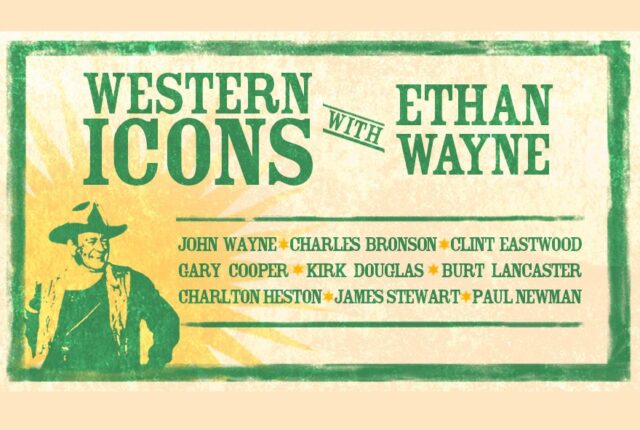
This morning, Ethan Wayne, the youngest son of legendary actor and icon John Wayne came in to share stories and photos of his father’s life through a new coffee table book out today, “John Wayne, The Legend and the Man“.

The book offers never before seen photos, and remembrances by Maureen O’Hara, Ronald Reagan, and Martin Scorsese, as well as an interview with Ron Howard.

Ethan shared some of the stories of behind the scenes life he had with his father, and his role as Director of John Wayne Enterprises.

Los Angeles Local News, Weather, and Traffic

Google+ Hangout

Order your copy of John Wayne: The Legend and the Man: An Exclusive Look Inside Duke’s Archives

Read more: http://www.myfoxla.com/story/20256887/john-wayne-the-legend-and-the-man#ixzz2EWf9mJ6B

John Wayne: Icon Of America’s Booming Confidence

Fox Photos/Getty Images
American actor John Wayne stands by the street sign honoring his name in Prescott, Ariz. The film star “was one of the defining Americans of the 20th century,” says critic John Powers.

Earlier this year (2011), the Harris Poll released its annual list of America’s 10 favorite movie stars. There, among today’s big names — Depp and Jolie and Clooney — was a lone name from the past: John Wayne. He finished third — 32 years after his death. Such enduring popularity served as a reminder that Wayne wasn’t merely a towering movie star, he was one of the defining Americans of the 20th Century.

When I was growing up, Wayne was a cultural given, a man whose fame and physical stature made him something of his own Mount Rushmore. It never occurred to me that the John Wayne we all knew was a figment, a hard-earned act of self-invention.

His given name was Marion Morrison, and he was born in Winterset, Iowa, a few miles from my hometown. Part of the great migration to L.A., Marion spent his adolescence trying to escape his parents’ unhappy marriage and to win his mother’s love — which, incidentally, he never did. A chronic overachiever, he won a football scholarship to USC, but poorer than his frat brothers, he had to earn money by serving them their meals. Like so many others, the mortified Marion found himself drawn to the democratic fluidity of a Hollywood that was invented by social outsiders.

Although Marion was quickly given a manly new moniker — he always thought of it as the single word, “Johnwayne” — he took his own sweet time becoming John Wayne. Over countless B movies, he taught himself to talk that strange hesitant talk, and he consciously created a trademark walk, all swinging shoulders and hips. Duke was ambitious, and when other male stars volunteered for WWII, he stayed home. Working in a Hollywood suddenly deprived of male stars, he made movie after movie, often playing the thing he pointedly was not — the indomitable American fighting man. No actor has ever been better at embodying male authority.

Wayne’s voice and manner are so easy to parody, it can take a while to grasp that he was a marvelous, canny screen actor. At his most ambitious, as in Red River, Rio Grande, The Searchers and Rio Bravo, he could act brilliantly. Yet even in routine pictures, he dominated the screen as few stars ever have, often by appearing to do nothing. A master of silence, he knew the camera, was the best reactor this side of Cary Grant and didn’t fear emotion. Wayne let you feel his deep affection for his screen soulmate, Maureen O’Hara, who brought out his tenderness and middle-aged rue.

Americans care less about authenticity than a good show, and though Wayne’s life wasn’t heroic — he personally drank and smoked enough for the whole cast of Mad Men — his screen roles made him something grander than a mere hero. He became this country’s “Idea of the Hero.” From the mid-’40s through the ’50s, Wayne embodied the American Century in all its booming confidence. If this sometimes meant embodying the darkness of our national past — Ethan Edwards in The Searchers is a genocidal monomaniac — that was never counted against his fundamental goodness. America’s Duke was tough, honorable, ready to laugh and share a drink, and always ready to do what men had to do in order to see justice done. He didn’t ask you to like him. He asked you to live up to him.

Over the years, Wayne’s monolithic image turned him into a cultural lightning rod. Even as he inspired decades of conservative iconography — you can find his echoes in Ronald Reagan, George W. Bush and Rick Perry — his Republican politics and patriarchal style made him a target during the 1960s and 1970s. Mocking Wayne was part of a whole generation’s rejection of authority.

But time moves on, and watching his work today, I don’t care who he voted for. I’m moved by his film’s portrait of an America whose confidence had yet to be shaken and by Wayne’s uncynical ability to embody virtues that are well worth preserving: the contempt for pettiness and love of hard work; the courage to be lonely in pursuing your goals; the respect for individuals in all their cussedness; and above all, the willingness to fight and die for a cause bigger than yourself. All of that is John Wayne, and it’s neither male nor female, conservative nor liberal. What it is, and always was, is American.

by JOHN POWERS http://www.npr.org/2011/10/07/140870373/john-wayne-icon-of-americas-booming-confidence

America, Why I Love Her

Happy Veterans Day, America!

John Waynes Classic Monogram Westerns Get a Makeover at Movies Unlimited

Philadelphia, PA (PRWEB) October 30, 2012
The films starring Wayne were made by Lone Star Productions and released in theaters by Monogram Pictures from 1933 through 1935. Although all of the films have been available on DVD from many different sources because they have fallen into the public domain (aka PD), these westerns are now available in newly copyrighted, digitally mastered and restored fine quality DVDs transferred from the original 35MM nitrate negative material.

Each movie in the series is presented with original music themes added by noted musician Billy Barber, who also wrote The Oak Ridge Boys hit Little Things and Ray Charles Love is Worth the Pain. Billy supervised the weaving of the new themes throughout the upgraded soundtracks.
This group of Monogram westerns are notable because they present The Duke in his formative years when he was perfecting his famous walk, heroic persona, trademark speech pattern and acting style. The films also showcase frequent sidekick George Gabby Hayes and famous stunt expert Yakima Cannutt, who usually plays one of the bad guys. Wayne and Canutt developed a number of stunts which eventually became part of every western movie.

The movie plots are interesting and sometimes complicated, but always end up with the same basic messages: The good guy wins out in the end, gets the girl, and vanquishes the bad guys. From time to time, Wayne seems to be the bad guy, but turns out to be an undercover agent, or a look-alike. At the time these films were made, there were no formal ratings — all films that could be theatrically distributed to the general public, and these were no exceptions, were the equivalent of what would today be “G” movies. Each title runs about 60 minutes and sells for $14.99. The list of restored titles includes:

Sagebrush Trail (1933): The Duke skips prison after being wrongly imprisoned for murder, then joins a gang of outlaws in hopes to finding the real guilty man.

The Lucky Texan (1934): Easterner Wayne heads west to join forces with Gabby Hayes in a mining operation that is terrorized by claim jumpers.

The Man from Utah (1934): Deputy Wayne has to enter the rodeo in order to expose a gang using dirty tricks at the meet.

Neath the Arizona Skies (1934): John attempts to save a Native-American girl who has been kidnapped by meanies out to nab the oil-rich land of which shes an heir.

Randy Rides Alone (1934): The Duke is tops as a lawman who goes undercover to target the rats robbing an express service.

The Trail Beyond (1934): Wayne goes out on a dangerous mission in the Northwest to find a missing girl and a gold mine that seems impossible to locate.

West of the Divide (1934): Our Man John goes back to his boyhood abode to track down his fathers murderer and his own missing brother.

The Lawless Frontier (1935): Wayne is in hot pursuit of his parents murderers and, after rescuing a prospector and his granddaughter, believes the killer is a Mexican bandit. But is it?

Paradise Canyon (1935): G-man John Wayne tries to halt counterfeiters working out of a cave headquarters near the Mexican border.

Texas Terror (1935): Sheriff Wayne puts his lawman responsibilities on hold in favor of panning for gold after he believes he killed a companion. Eventually he learns a secret from the late mans sister.

For complete movie descriptions including cast members and more, head over to our remastered John Wayne Lone Star westerns. The quality of this John Wayne collection is so superior to the PD versions, that the recorded owner of the distribution rights, used them as the basis for new masters, with materially improved sound and picture quality, and are now being offered by Movies Unlimited. You can also read more about this classic Western collection at our blog: John Wayne’s Back in the Saddle.

Movies Unlimited is one of the worlds oldest and most reliable video retailers of DVD and Blu-ray titles, specializing in hard-to-find movie classics. The John Wayne features can be ordered through their web¬site or by calling 1-800-4-MOVIES. The Philadelphia-based company also publishes their annual encyclopedic 800-page Movies Unlimited DVD Catalog.