Archive for category Interviews

John Wayne: The Legend & The Man (Ethan Wayne Interview Video)

This morning, Ethan Wayne, the youngest son of legendary actor and icon John Wayne came in to share stories and photos of his father’s life through a new coffee table book out today, “John Wayne, The Legend and the Man“.

The book offers never before seen photos, and remembrances by Maureen O’Hara, Ronald Reagan, and Martin Scorsese, as well as an interview with Ron Howard.

Ethan shared some of the stories of behind the scenes life he had with his father, and his role as Director of John Wayne Enterprises.

Los Angeles Local News, Weather, and Traffic

Google+ Hangout

Order your copy of John Wayne: The Legend and the Man: An Exclusive Look Inside Duke’s Archives

Read more: http://www.myfoxla.com/story/20256887/john-wayne-the-legend-and-the-man#ixzz2EWf9mJ6B

Growing up as John Wayne’s son in O.C.

NEWPORT BEACH – Ethan Wayne, as his surname implies, is one of the seven children of John Wayne, one of Orange County’s most famous residents.

Despite that, Ethan Wayne insists that his life growing up was “not typical Hollywood at all.

“Our life was basically small-town beach life,” the 49-year-old Wayne said. “(Dad) drove a station wagon. He shopped at White Front and Sears.”

Newport Beach was a much smaller place back then, he said, admitting the routinely heavy traffic on Coast Highway tends to irritate him.

Still, he has no intention of leaving his hometown for locales elsewhere.

John Wayne left the San Fernando Valley for Newport Beach in the 1960s. Even before Wayne lived in Orange County, he frequented Newport Beach. In fact, he lost his football scholarship with USC because he injured himself surfing there.

“He had a long history himself down here. Newport was a smaller beach and fishing town,” Ethan Wayne said. “At that time, it was much more low-key.”

The Wayne family lived in a home Ethan Wayne characterized as in a regular neighborhood. One neighbor a couple of doors down was a single mother who worked as a dental hygienist.

There were no big fences, no checkpoint in the driveway … though John Wayne once joked he needed to wear a wig when he went out front to water the lawn.

“There weren’t paparazzi. We didn’t have bodyguards. (Dad) answered the phone; he answered the door,” Ethan Wayne said. “My life was pretty normal for having such an iconic, legendary father. … We did get a lot of mail.”

Ethan Wayne still lives in town, though he admits it’s grown – and a bit too much.

“I saw a paid parking lot the other day, and it annoyed me to no end.”

But he still likes it for the same reason his father did: The lapping waves of the Pacific Ocean.

After travelling with his father for most of his childhood, Ethan Wayne returned to the motion-picture industry as a stuntman, spending several years crashing cars and taking tumbles.

His first gig was working for stunt coordinator Gary McLarty doing “Blues Brothers.”

“It was a natural transition,” Wayne said. “As a kid, I grew up around the stuntmen. I had a relationship with these guys. They knew I could drive a car or motorcycle and do the fight.”

He also made appearances in “Knight Rider” and “BJ and the Bear.”

That led to guest appearances on those shows, and an eventual transition to acting.

“I liked acting better, because stunt work can escalate to where it gets pretty dangerous,” Wayne said. “You have to do it when it’s cold dark and rainy. You have to be a professional about it and doing it 10 times over.”

In the 1980s, he played attorney Storm Logan on the soap, “The Bold and the Beautiful.”

The show had been on in the U.S. for four years when it began airing in Italy and became a hit. That made Wayne an international star. At one point, he kept rental homes there, because he visited so often promoting the show.

Though he more often stays closer to home these days, Wayne is no stranger to travel.

Much of his youth was spent on the Wild Goose, John Wayne’s beloved yacht.

For Ethan Wayne, it was no luxury liner. He had to earn his keep.

“On the boat, you had chores. You mopped the deck, you wiped down the rails … hauling garbage,” Wayne said. But it was worth it, he added. “It was like being on Jacques Cousteau’s team. It was a constant adventure. …

“I didn’t know when it was winter, summer, Halloween or whatever, because I was waiting for my dad to say, ‘We’re going this way,’ or ‘We’re going that way.’”

When not on the water, Wayne travelled with his father from filming location to filming location.

Much of that time they spent in the Mexican state of Durango, where an Old West main street was built in the middle of the high desert.

“I loved it. I liked being with my dad … in Mexico – in the wilderness. You’re in John Wayne country. For me, it was like growing up on a ranch or going to camp. … I wish I could go back there.”

John Wayne loved Mexico. There, he got the same recognition, “if not more so than back home,” Ethan Wayne said. “He spent a lot of his career in Mexico. He married three Latin women.”

One of them, a Peruvian woman named Pilar Pallete, spent 27 years with John Wayne. They had three children together: Marisa; Ethan; and Aissa.

Ethan Wayne looks like his father, and has a calm demeanor. His speech carries his emotions. He isn’t idle.

He’s president of John Wayne Enterprises, the company that manages John Wayne’s image and the merchandising that goes along with it, from Wayne-inspired Western wear to small-batch Bourbon and organic beef jerky.

He also heads the John Wayne Cancer Foundation

John Wayne recovered from having lung cancer in the 1960s, but died in 1979 from stomach cancer. Before he passed, he decided to help others suffering from the disease.

The foundation funds awareness programs, support groups, cancer research, trains oncologists through the John Wayne Cancer Institute.

“In my opinion, my father’s greatest legacy is helping people who are sick,” Ethan Wayne said.

Wayne also hasn’t left Hollywood completely. He’s currently writing a screenplay.

“I am concentrating on this, though I am working,” he said. “It’s a human story about choices that we make when we’re young and how they affect us when we get older … the emotional consequences of turning right or left. It’s set around a life that’s somewhat adventurous.”

A kind of life, it seems, Wayne knows something about.

By MICHAEL MELLO / THE ORANGE COUNTY REGISTER

MARK RYDELL REMEMBERS KILLING JOHN WAYNE…AND BETTE MIDLER!

June 11th marks the 30th anniversary of the passing of screen legend John Wayne. Most of the directors who made his classic films are of course long gone as well, so I was very pleased to sit down with Mark Rydell, director of The Cowboys (1972), the epic cattle drive saga most Western fans regard as Wayne’s last great starring role.

Rydell began directing theater in New York City in the early sixties, and went on to television and movies, including hits like The Rose (1979) and On Golden Pond (1981). We met at The Actors Studio in West Hollywood, where he and co-director Martin Landau continue to moderate acting classes.

JON: When did you first join The Actors Studio?

MARK RYDELL: The fifties. I went through the Neighborhood Playhouse in 1949; I studied with Sanford Meisner for two years, then I was very fortunate to be on “As the World Turns” for many years, so I avoided a lot of the unemployment agony so many actors go through.

The first time I auditioned for the Actors Studio, they turned me down. I was enraged that they would reject me… but Elia Kazan, Lee Strasberg, and Harold Clurman thought I needed a little more seasoning. Once I got in, I became Kazan’s assistant, and he was very helpful to me in my own career. He was simply the greatest director of actors I’ve ever been exposed to. There’s a new book out about him; it just came out a week ago, called Kazan on Directing. Wonderful book.
One passage I always remember from his autobiography is when he said that after winning the Oscar for directing his third movie (Gentlemen’s Agreement, 1947), he figured it was time he learned something about camera work. Apparently, all he did was work with the actors initially, and left the visual style entirely in the hands of his cinematographers.

It’s true. When you’re a theater director in New York, and then you come to Hollywood to direct a picture, suddenly you’re in charge of all these crews; the lighting people, the sound, all these technical things. Something I’ll advise young directors to do is go to museums and study paintings. You know, how do you create a frame that’s filled with dramatic tension? You learn about composition…

I’m always interested in how painters “light” things.

Sure. Look at any Rembrandt painting; see where the light source is, how it affects the subject, where the shadows are. When you direct theater, your main tools are the actors and the script; when it comes to movies, you have to expand your judgment to the various aspects of visual presentation.

Though I get the sense not a lot of movie directors are coming out of theater anymore. People coming in seem to be mostly from commercials and music videos.

And you know what the problem is with those commercial guys? They only know how to keep it alive for thirty seconds. They’re very skilled, these directors—staggeringly brilliant and sophisticated visually—but I find they rarely understand the depth of written material. So many commercials today don’t even tell a story, or have anything to do with the product; they’re literally just thirty seconds of dazzling images… so you’ll associate the product with something you found viscerally exciting.

Rydell’s debut feature film, The Fox (1967), was based on a D.H. Lawrence story, and won the Golden Globe for Best Drama. His second film, The Rievers (1969), was adapted from the Pulitzer Prize-winning novel by William Faulkner.

That’s kind of unusual, starting a feature career with two prestige pieces. Most people have to start with trash.

I did plenty of trash. That was television: you’d get a script for something like “The Ben Casey Show” or “Dr. Kildare;” you read it, and you see it’s crap. So what do you do? You have to work. So you find something in the material that moves you, something private, and you let that private interest shape the rest of it, so by the time you’ve finished directing your “Gunsmoke” or whatever, you think it’s the best thing you’ve ever done.

I assume what generally moved you back then was working with the actors?

That’s probably my dominant skill. I think it’s a pleasure to work with actors; they’re so vulnerable, they’re so available, they’re so geared to do the right thing…

But being an actor yourself, you appreciate them because you know their process. I think a lot of directors regard actors like they’re space aliens. And I think it’s worse for men. It’s “cute” when women dedicate themselves to acting, but when a man does it… I think a lot of people see it as un-masculine.

Marlon Brando used to say that to me; that acting was a child’s game, and not for men. He was a very tough guy. Strong, sensitive, very competitive; an amazing actor—his ability to accept imaginary circumstances and behave within them was incomparable—but he was very unhappy. A sad, sad fellow.

And then there was John Wayne… How did you get involved in The Cowboys?

An agent walked in and put an unpublished novel on my desk. I sat down and read the first fifteen pages or so, and it was about this man who loses all his ranch hands to a gold rush. He’s got 1,500 head of cattle to get to market, and he walks into a schoolhouse. I knew I had a movie right there.

Did you have any particular affinity for Westerns?

I was from the Bronx; I’d never been on a horse in my life. I watched Westerns growing up, but I felt apart from them. It wasn’t my department. But doing all those “Gunsmoke” episodes—maybe a dozen or so—was a big help. We shot them in Thousand Oaks, which was really open country back then. Twenty minutes from L.A., and there wasn’t a telephone line in sight.

So I took that Cowboys manuscript to John Calley at Warner Bros., threw it on his desk, and said, “You’ve got 24 hours to make a decision on this before I go elsewhere.” He said, “Arrogant, Mark, aren’t you?” I said, “Absolutely. This is a big deal.” He called me an hour later, and said we had a deal.

So John Wayne wasn’t even involved yet?

No, and I didn’t want him; I wanted George C. Scott. But they had a deal with Wayne, and Calley said, “Let’s just go meet with him. He really wants to do it.” He was shooting in Mexico, so we got on the Warner Bros. jet…which I thought was terrific, but it was ultimately charged to my Cowboys budget. Nothing’s free!

I was absolutely stunned by John Wayne. I mean, he was the exact opposite of all my ideals—he was very right wing, one of the founders of the black list in the fifties—and I was this Jewish musician from the Bronx with pretty liberal views. So there I am sitting with him. He shook my hand—my hand disappeared inside his, it was so big—and he said, “I’d really appreciate it if you gave me the chance to play this part, sir.” I was completely seduced by him. I told him, “Let’s never talk about politics, let’s just talk art.”

And he was fabulous; the first guy on the set every morning, and the last guy to leave at night. This man I had loathed… I had disagreed with every position he’d ever taken, but I learned a lot from him, about determination, and commitment.

Wayne and Rydell, above, on the set of The Cowboys.

Wayne and Rydell, above, on the set of The Cowboys.

What I’ve read about his late career is that he surrounded himself with cronies, from the directors and writers on down. It sounds like that wasn’t the case here.

Nope. I had him alone. And he called me “Sir” for the whole picture! I was a kid, in my thirties, and he was a giant, a 6’ 5” walking icon. It was amazing. We shot it all around Santa Fe, and to walk into a restaurant there with John Wayne… everybody came over for autographs… and I never saw him turn away a single fan.

He certainly looks like he’s enjoying himself in the picture. So I guess, unlike Brando, he never tired of stardom. He really loved being John Wayne.

And he loved being with those kids. And they adored him as well; they climbed all over him like he was jungle jim. He also loved that I cast a bunch of people from The Actors Studio around him, like Roscoe Lee Browne and Bruce Dern. He was very keen to appear with them; he really wanted to show that he was as good an actor as they were.

Yeah, Roscoe Lee Browne is amazing in it. I can’t think of a Western that ever had a better role for a black actor. His presence, his voice… he was like Orson Welles.

I first directed Roscoe in a play called “Bohikee Creek” at The Actors Studio. He and Billy Gunn played these dirt poor clam diggers off the coast of South Carolina; for the whole play, they talked like, “We gone git dat boat, an’ den we gone do lahk…” Well, the reaction from the audience was tremendous, and the two of them came out afterwards to answer questions. When Roscoe began to speak in his own voice—these beautiful, melodious tones—people were just stunned. They couldn’t believe it.

Wayne, far right, and the cowboys.

Wayne, far right, and the cowboys.


So much was made at the time that Bruce Dern played the first villain to ever kill John Wayne in a movie. Is that actually true?

It wasn’t so much that he died, but that he got killed so far before the end. There’s still another whole act left to go.

The brutality of it is also pretty shocking, given that the tone of most of it is fairly benign. Then those bullet hits come… it’s like a scene out of Peckinpah.

Exactly. That’s what we wanted. That it comes like a slap in the face.

Also, when you think about that era—the early seventies—I’m sure a lot of John Wayne’s fans savored those moments in his movies when he kicked some hippie ass. I can just imagine all these tough guys going to The Cowboys… and sitting there in disbelief when this squirrelly, longhaired punk actually gunned down the Duke!

Bruce only half-jokingly said it ruined his career; that people just thought of him for years as the psycho who killed John Wayne.

Of course, psychos were already his stock in trade; he’d been doing it in those biker movies for years. I’m guessing The Cowboys was probably the first time a lot of mainstream America really noticed him. And he’s absolutely riveting; one of the greatest Western bad guys of all time I think. And he doesn’t even have that many scenes.

But he sure makes the most of them. That scene where he’s dunking the kid in the water… see, Bruce was very smart: he never got friendly with any of those kids. He was very cold to them, so of course they all felt intimidated by him. “Why doesn’t Bruce like me?” So when it came to that scene, where he threatens to drown the kid, or later, when he crumples the glasses—there’s not a lot of acting there; that boy was scared.

They say you should never work with children or animals. How hard is it keeping control over a herd of cattle and a cast full of kids?

The cattle drive was really quite complex. We had maybe twenty outriders, ready to come in and rescue somebody in case there was a problem. The kids really were herding those 1,500 head of cattle, and John Wayne insisted on doing everything himself; he had no stuntman. Even in the beginning, when he’s fighting that horse—that’s all him. All that tough riding; he did it all. He was an amazing guy; he just blew my mind. I consider it a major privilege that I spent those 102 days with him. And he was so pleased with the picture.

By Jon Zelazny, The Hollywood Interview

Read the full post at The Hollywood Interview blog.

Hanging Out With Ol’ Dobe

An Interview with Western film star Harry Carey, Jr.

The other day I met with Western film star Harry Carey, Jr. and his wife Marilyn, and it was like hanging out with old friends. They were gracious enough to grant an exclusive interview to Wonders of the West to highlight the Golden Age of Western Film making and talk about what they’re up to these days.

For those who don’t know, Harry Carey, Jr. is a very well known actor from the golden era of the Westerns, appearing in over 100 Western films and television series from the 1940′s through the 1990′s. Read the rest of this entry »

Honoring the Duke

Michael Wayne Talks About His Famous Father And The Qualities That Made Him An American Icon

True legends need no introduction, only a moniker. The mere mention of “the Babe” brings to mind the House Ruth Built much the same way “the Golden Bear” conjures up Augusta. When it comes to the American West and all it represents, one name stands out head, hat, and shoulders above all others: “the Duke.”

John Wayne’s performances in The Searchers and Stagecoach not only topped Cowboys & Indians list of the 100 Best Westerns, but he also starred in 16 other featured selections for a total of 18 picks— twice the number of runners-up Clint Eastwood and Henry Fonda. And the Duke’s appeal was not limited to just C&I readers either. Academy Award winners Tommy Lee Jones and Jack Palance and film critic Leonard Maltin were just a few of the celebrities who tipped their hats to the Duke with their selections.

Cowboys & Indians journeyed to the Beverly Hills office of the production company John Wayne founded. There, his son Michael oversees the ongoing business of maintaining his fathers legacy—licensing the use of his image, modernizing films such as McLintock! and Hondo for DVD, and continuing his father’s legacy with the John Wayne Cancer Institute. What follows are excerpts from portions of a recent conversation between Michael Wayne and Gregory L. Brown, chairman and CEO  of Houston-based USFR Media Group, the parent company of Cowboys & Indians.

GREGORY BROWN: Let’s begin by talking about the American West.

MICHAEL WAYNE: The West is totally unique to the United States of America. It’s like knighthood and chivalry in England. The West, at least for me, is right after the Civil War until about 1900. From that short period of time have sprung all the songs, all the poetry, all the novels, the movies, the television shows, and the values. And I think that people identify with them. It’s our folklore, our history, and it’s a very different history than any other country has had.

BROWN: Thus the importance of the cowboy.

WAYNE: When anybody in the world sees a man with a big, broad-brimmed hat and pointed boots, he’s American. He’s a Westerner. They know it. They
know it from T\d they know it from movies, and they also know it from photographs.

BROWN: Stagecoach was such a pivotal step for your father’s career as well as the development of the Western genre. How many films had your father completed when he got a crack at the Ringo Kid?

WAYNE: The truth is I think it was about his 64th or 65th film.

BROWN: That many?

WAYNE: He had done all sorts of B Westerns, but it was Stagecoach that really catapulted him into stardom. Don’t forget that Claire Trevor who portrayed Dallas got first billing in Stagecoach. She was a much bigger star than he was at the time. Stagecoach really launched him from B pictures into Class A type films, and at the same time it also launched the Western genre into Class A films.

BROWN: How did he go about landing the part?

WAYNE: Through director John Ford. Ford and my father were close friends. My father had worked for him as an assistant director, as a stuntman, as an extra, and as an actor in bit parts. John Ford was really his mentor.

BROWN: How did Ford help him get the part?

WAYNE: Ford was going to direct Stagecoach for Walter Wanger, a very fine producer, and Wanger was not that thrilled about having my father as the star because my father had established himself as a star of B films. Some people said that Wanger wanted Gary Cooper.

BROWN: How did Ford go about getting around Wanger?

WAYNE: Ford tested a lot of actors. One was a personal friend of my father’s, named Bruce Cabot. And he had some heat on him. He’d starred in King Kong, a very successful film. Bruce went to do the test. They had a stagecoach there and all the Western gear. So Bruce did what Mr. Ford asked him to do, he climbed up on the stagecoach and grabbed the reins. Then they blew dust over him with a wind machine to see how he would look on film. Then he jumped down off the stagecoach, went up to Mr. Ford and said, “Pappy, how’d I do?” And Ford said matter-of-factly, Bruce, you were really great, but Duke’s got the part.” So it was apparent that Ford was just going through the motions in testing the other actors; his mind was made up.

BROWN: That was just the start.

WAYNE: That’s right. Soon afterwards, Mr. Ford called my father into his office. There was a holster and a gun belt sitting there with a gun. He said, “Duke, can you use that thing?” So my father put the belt on, twirled the gun and did other tricks, then smoothed it back into the holster. I Ford smiled and said, “Well, that’s pretty good, but you’re not going to
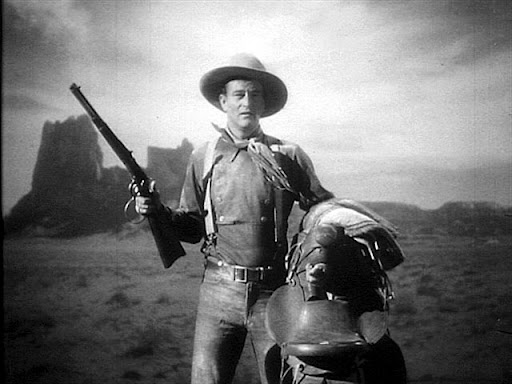
have a pistol or a gun belt in this picture. I’m giving you a rifle, and what you are is a farmer, a plowboy. You’re not a ‘fast gun’ like you were in all those B Westerns.” And that started my father thinking. The script called for him to carry a saddle in one hand and this rifle in the other for a good portion of the film. If he had to shoot the rifle and anybody threw something to him, he had to drop something to handle it. So he got together with Yakima Canutt, who was the stunt coordinator on Stagecoach and said, “Yak, I’ve got to drop the saddle to shoot the rifle. How am I going to do all that?” So they Canoe up with a large loop Winchester. He was able to cock it, twirl it, cock it, and fire it, all with one hand. And so that’s how the famous John Wayne Winchester came to be, and he carried it throughout all the films that he was in thereafter.

BROWN: Does your family still have that Winchester?

WAYNE: No, its in Oklahoma City. He donated it to the National Cowboy Hall of Fame along with the saddle and the pistol he used in Western films.

BROWN: Let’s go beyond Stagecoach. Who were your father’s favorite co-stars?

WAYNE: He loved working with anybody and everybody. And, of course, the better they were, the better he was. He loved John Ford’s stock company. Were talking about Henry Fonda, Harry and Dobie Carey Victor McLaglen, Ward Bond, and Hank Worden—a whole list of people that were really good actors, including stuntmen. Many of those stunt men were naturals.

BROWN: How about female leads?

WAYNE: Definitely Maureen O’Hara. There was a lot of chemistry between he and Maureen. They made five films together. As far as I’m concerned they were the sort of duo that Tracy and Hepburn were

BROWN: How did John Wayne become so larger than lift?

WAYNE: Well, to an extent, he was. The composer Dimitri Tiomkin [Red River, Rio Bravo, The Alamo] once told me the reason he loved to write music for films with my father was that his shoulders were so broad, he could carry a massive score. With other stars, he said, “we can’t really play our ass off with a big orchestra. It diminishes the actor. But not John Wayne.”

BROWN: Was it just his on-screen personal

WAYNE: Obviously his films played an important part in it. Besides his many Westerns, he also made 27 military films.. But I think it was as much how he was off the Screen as he eras on the screen because he had really strong, strong values and ideals. He had great respect for others, but he demanded respect from them, too. He had integrity honesty, and courage.

BROWN: Was he a religious man?

WAYNE: Let’s say, he was a believer. He believed in God. He didn’t really have a formal religion of any kind and he wasn’t running to church every five minutes, but he had a strong belief and respect for the Almighty and a strong moral Compass and I think that because he had these things in him, these values and these ideals, he was able to project them on the screen. They were inside him. They were believable. He wasn’t just acting—he really felt that way. And I think that people realized that.

BROWN: Even his detractors?

WAYNE: People didn’t always agree with him. He was pretty outspoken about a lot of things, about everything really, and he had his own personal ideas. But he never lied to anybody, and people appreciate that. They also knew he wasn’t trying to be anything except who he was. And he knew what Space he occupied. You look down at your feet; that’s what you occupy That’s it.

BROWN: As the keeper of the flame what is your mission to maintain your father’s place to Americans?

WAYNE: He’s already earned his spot in history, so I don’t have to do anything to maintain his standing. I work with people to protect his image because he’s not here to protect himself. Of course I also like to cooperate with the press and remind people about the things my father thought were important.

BROWN: Give us an example.

WAYNE: They have beautiful sunsets in Durango, and we were making a movie. There was this big wooden rocking chair on the porch where ma father Stared, and he said to me, “Come up here, sit down, and look at this sunset.” And I toll him that I couldn’t. There was work to do for the next day’s shoot, and it was my job to make sure everything was in place. He said, “Let me tell you—the work will be there. It’s going to be there tomorrow, but this Sunset isn’t going to be there. Don’t miss it.” He had a balance in his life. He was in Sync with the world around him.

BROWN: He seem d to have a good sense of perspective.

WAYNE: That he did. My father once told an interviewer, “Tomorrow is the most important thing in life. It comes in to us at midnight very clean. It’s perfect when it arrives, and it puts itself in our hands and hopes we’ve learned something from yesterday”.

Courtesy of Cowboy’s & Indians magazine